
Addition Worksheets
Printable addition worksheets that build step by step: from adding within 10 with pictures and number lines, to facts within 20, two-digit sums without and with regrouping, three-digit column addition and word problems. Every sheet has an answer key, and an Excel fact-fluency tracker helps you see progress.
- Instant download
- Editable Word & Excel
- Print-ready PDF
- 7-day refund
10 files · PDF, DOCX, XLSX
Addition Worksheets Pack
Printable addition worksheets with answer keys: within 10, number lines, within 20, doubles, two-digit with and without regrouping, three-digit, three addends and word problems, plus an Excel fact-fluency tracker.
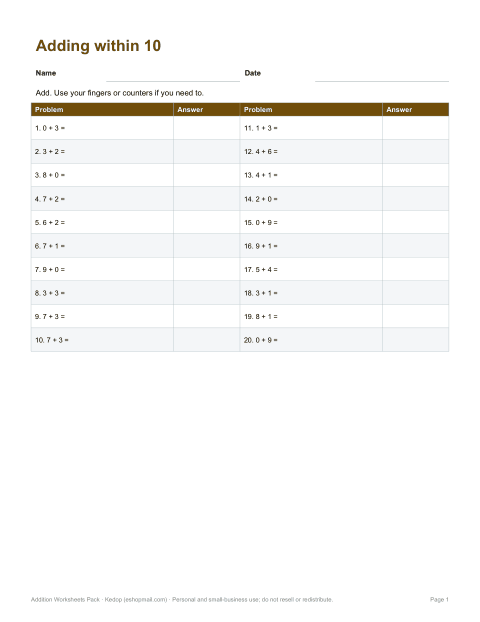
- Within 10 (PDF, DOCX)
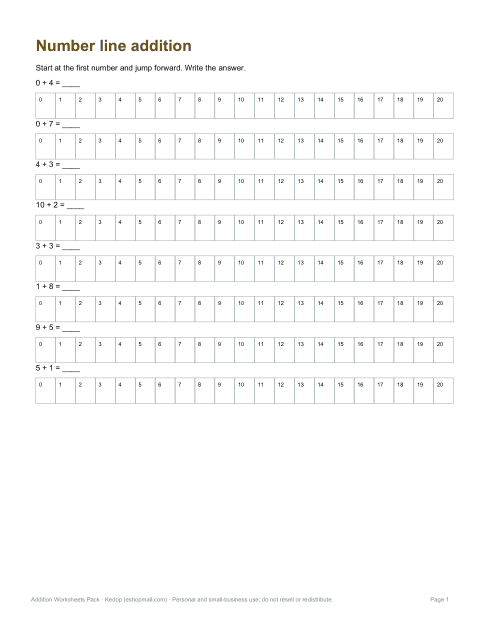
- Number lines (PDF)
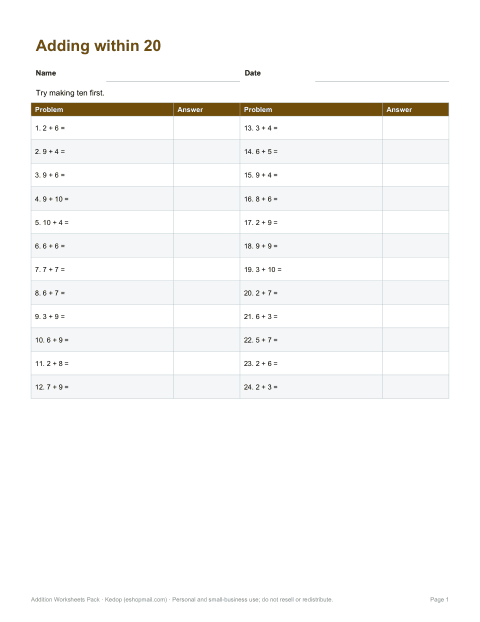
- Within 20 (PDF, DOCX)
- + 7 more
$5.00 USD, one-time 10 files · about $0.50 each
- Instant download
- 7-day refund
- Secure checkout by Stripe
7-day money-back guarantee. Full refund within 7 days of purchase, even after you download.
Free sample: Adding Within 10 (PDF, 61 KB)
Addition Worksheets Pack
Printable addition worksheets with answer keys: within 10, number lines, within 20, doubles, two-digit with and without regrouping, three-digit, three addends and word problems, plus an Excel fact-fluency tracker.
- Within 10 (PDF, DOCX)
- Number lines (PDF)
- Within 20 (PDF, DOCX)
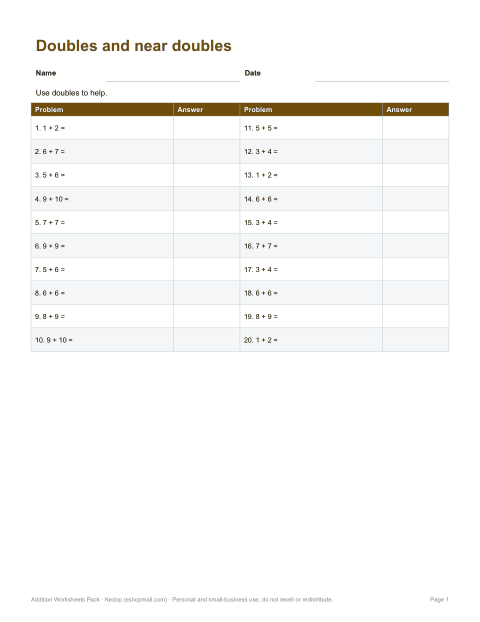
- Doubles (PDF, DOCX)
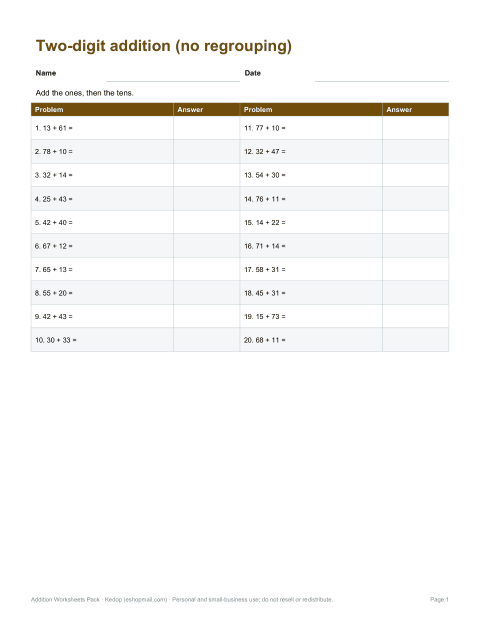
- 2-digit, no regrouping (PDF, DOCX)
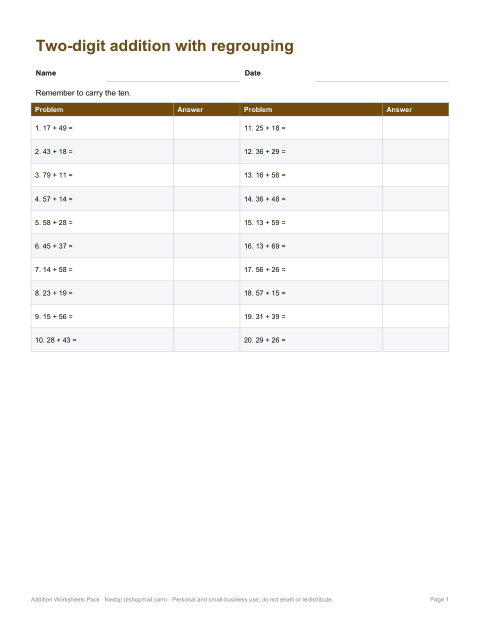
- 2-digit, regrouping (PDF, DOCX)
- 3-digit (PDF, DOCX)
- Three addends (PDF, DOCX)
- Word problems (PDF, DOCX)
- Fluency tracker (XLSX)
Formats: PDF, DOCX, XLSX. Instant download after payment (link valid 72 hours, up to 5 downloads). AI-assisted: the templates were drafted with AI help and reviewed and laid out before publishing.
$5.00 USD, one-time 10 files · about $0.50 each
- Instant download
- 7-day refund
- Secure checkout by Stripe
7-day money-back guarantee. Full refund within 7 days of purchase, even after you download.
Free sample: Adding Within 10 (PDF, 61 KB)
Full refund within 7 days — see the refund policy and license.
Free printables
Single sheets you can print right now, no sign-up. The full pack adds every sheet in one download plus the editable files.
 Within 10 Addition Worksheets2 pages · free PDF
 Printable Number Line Addition Worksheet1 page · free PDF
 Within 20 Addition Worksheet2 pages · free PDF
 Doubles and Near Doubles Worksheet2 pages · free PDF
 2-Digit Addition No Regrouping Worksheet2 pages · free PDF
 2-Digit Addition with Regrouping Worksheet2 pages · free PDF
 Printable 3-Digit Addition Worksheets2 pages · free PDF
 Printable Three Addends Addition Worksheets2 pages · free PDF
Worksheets in the pack
| Worksheet | Skill | Typical grade |
|---|---|---|
| Adding within 10 | Single-digit facts, sums to 10 | K–1 |
| Number line addition | Counting on along a number line | K–1 |
| Adding within 20 | Facts to 20, making ten | 1 |
| Doubles and near doubles | 6 + 6, 6 + 7 | 1–2 |
| Two-digit, no regrouping | 34 + 25 | 1–2 |
| Two-digit with regrouping | 47 + 38 | 2 |
| Three-digit addition | 356 + 278 | 2–3 |
| Adding three numbers | 7 + 5 + 3 | 1–2 |
| Word problems | Addition in context | 1–3 |
How to teach addition step by step
- Start with objects: count two groups together, then count on from the larger number.
- Use a number line to show counting on: 5 + 3 means start at 5 and jump 3.
- Learn facts to 10 until they are automatic, including number bonds (7 + 3, 6 + 4).
- Use “make ten” for facts to 20: 8 + 5 = 8 + 2 + 3 = 13.
- Move to place value: tens and ones, with base-ten blocks.
- Introduce column addition without regrouping, then with regrouping.
- Practise little and often; five minutes a day beats a long weekly session.
Regrouping (carrying) explained
When the ones add up to 10 or more, we regroup ten ones as one ten. In 47 + 38, the ones make 7 + 8 = 15: write 5 in the ones column and carry 1 ten to the tens column. The tens then make 4 + 3 + 1 = 8, so the answer is 85. Base-ten blocks make this concrete — ten unit cubes are swapped for one rod. Many children understand regrouping better if they first add tens and ones separately: 40 + 30 = 70, 7 + 8 = 15, 70 + 15 = 85.
Mental strategies worth teaching
- Counting on from the larger number.
- Doubles (6 + 6 = 12) and near doubles (6 + 7 = 13).
- Making ten: 9 + 6 = 10 + 5.
- Compensation: 29 + 16 = 30 + 15.
- Adding tens first: 45 + 23 = 65 + 3.
- Commutativity: 2 + 9 is the same as 9 + 2 — start with the bigger number.
Word problems
Word problems connect addition to real life. Encourage children to read carefully, underline the numbers, decide what is being joined or combined, draw a picture or bar model, and write the number sentence before solving. Key words such as “in all”, “altogether” and “total” often signal addition, but understanding the story matters more than spotting words.
Making practice fun
- Turn worksheets into games: race a timer, then try to beat your own score.
- Use dice or playing cards to make new sums.
- Colour-by-answer pages reward accuracy.
- Let children create their own word problems about family, pets or toys.
Using the answer keys
Each worksheet has an answer key on the next page. Let children check their own work where possible — noticing and correcting mistakes builds understanding. Look for patterns in errors: forgetting to carry, adding from the left, or miscounting on a number line each point to a specific skill to revisit.
Fact fluency tracker
The Excel tracker records timed fact practice — date, worksheet, number correct, time taken — and calculates accuracy and facts per minute so progress is visible. Celebrate improvement rather than speed alone.
Formats
Print-ready PDF worksheets with answer keys (US Letter; A4 with “Fit to page”), Word versions of selected sheets and an Excel tracker.
Frequently asked questions
What age are the addition worksheets for?
Roughly kindergarten to grade 3 (ages 5–9), from facts within 10 to three-digit addition.
Do the worksheets include answer keys?
Yes, every worksheet has an answer key.
What is regrouping in addition?
Exchanging ten ones for one ten (carrying) when a column adds to 10 or more.
How often should children practise?
A few minutes daily is more effective than long, infrequent sessions.
Was AI used to create the worksheets?
Problems were generated by script and instructions drafted with AI assistance, then reviewed before publishing.